
Athletes share their experience with female toxicity and the changes they want to see.
By Emma Bolzner
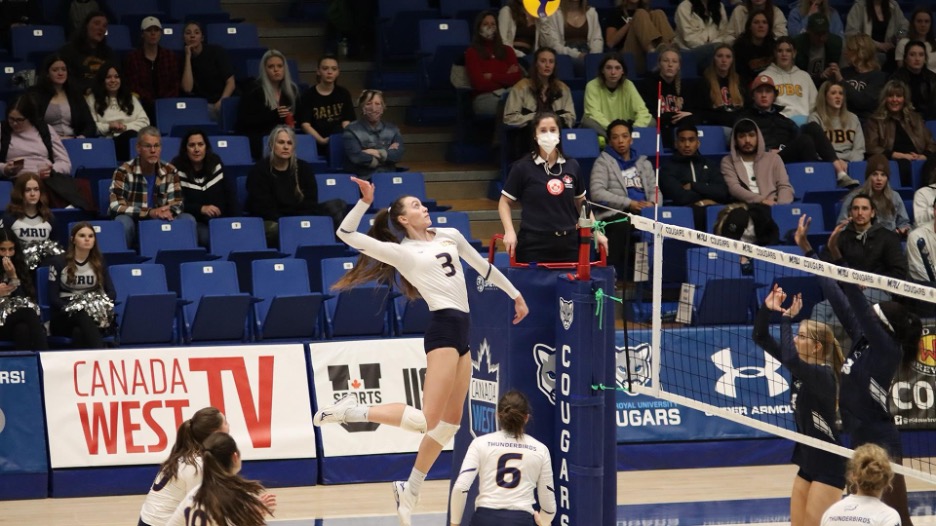
When Elise Petit found out she was good enough to play volleyball at an Ivy League school, she was more than overjoyed, as it was a dream come true for her.
Petit began playing volleyball in Grade 6 and gave up horseback riding to pursue the sport competitively.
However, once arriving at Dartmouth College, Petit realized this dream would not turn out the way she imagined, at least not at this school.
“At Dartmouth, I was calling my parents every day asking them to please let me quit. I did not want to play volleyball anymore. I hated it,” Petit said.
Petit says the team was toxic and she began to dislike playing volleyball because of it.
Although male toxicity within sports is more commonly addressed, female toxicity can often be overlooked, especially when it is caused by teammates and coaches.
“It was not an inclusive team and I wasn’t friends with most of the girls. I wanted to play, I just didn’t want to play on that team and I felt trapped. There was definitely a period of time where I was like, ‘I can’t do this anymore. This is just awful,’” Petit said.
Petit says Dartmouth was seen as an extremely privileged place and this mentality was reflected through the team, contributing to female toxicity.
“I remember at Dartmouth my team had planned to do something outside of practice and a bunch of us got ditched. I just experienced a lot of cattiness, like ‘we don’t need to include her,’” Petit said.
“This was a turning point for me because I realized I was not valued by my teammates. Not as a player or as a person. They just didn’t like me,” she said.
Dartmouth also did not have neutral facilities for athletes to seek help if they were experiencing a problem with their teammates and coaches.
“The expectations on the team at Dartmouth was to ‘just shut up and do it,’ which I tried to embody because I felt like I had to,” she said.
“Everything went through our coach, so if you had a problem, the coach always ended up being involved. I remember a teammate who had an issue with our coach, set up a meeting to talk with them, but after that she never played again because she was in retaliation,” Petit said.
Now playing for the UBC Thunderbirds women’s volleyball team, Petit’s experience is completely different.
“My teammates at UBC are supportive and it is a better environment to play in than at Dartmouth. We grab dinner afterwards and we are very supportive to one another,” she said.
Sarah Moore, an assistant professor at Dalhousie University for health and human performance and a contributor to the 2018 ParticipACTION Report Card on Physical Activity in Children and Youth, says it is important for girls to be physically active and start learning healthy habits early on in life.“Girls who are less active are more likely to become women who are less active. Activity can be an important contributor to overall daily and lifelong habits,” Moore said.
There are also extreme health benefits for young women who are physically active and are involved in team sports.
“They show higher self-esteem, confidence and lower levels of depression and anxiety. Girls who engage in less activity are more likely to be on screens more and have poorer sleep,” Moore said.
Meghan Camplin is the captain of UBC’s rowing team. She has been rowing for eight years and still enjoys the rush of excitement she gets when she goes out on the water.
Camplin says her sister encouraged her to join the rowing team in high school and she has never looked back since.
“When I first get in a boat I feel the connection instantly. It is just super exciting. I love the feeling of going fast,” she said.
Like most sports, rowing is competitive, especially when teammates fight for a seat in a boat.
“You have to be fast to be in the fastest boat. There are only eight seats, but there are 28 girls on the team who are all fighting to get a spot. This can cause conflict within a team, especially when people start thinking others don’t deserve to get a seat,” Camplin said.
Rowing is a unique sport, because athletes have to work as one to succeed.
Camplin says the pressure from other teammates can cause tension if one person is out of sync with the rest.
“Even though you have to earn your seat on your own, you have to rely on your teammates in order for the boats to go fast. Everyone has to work together and support each other. We also have to trust that we are all working hard to get where we want to be,” Camplin said.
Although Camplin has never wanted to quit rowing due to toxicity, she has been bullied by teammates and has moments of doubt.

“I try not to let other people’s opinions of me affect me that much,” she said.
“You spend a lot of time with the same people and it can get irritating. There are times after practice on the drive home, when you hear a teammate gossiping about someone else. Usually it revolves around a teammate being spiteful over someone else getting a seat in a boat. To me this is what I would label as a toxic environment.”
Camplin thinks female toxicity can be avoided if teammates shut down negative behaviour as soon as it begins.
“It starts at the root of the people who make up the team and I think it just comes down to whether people are willing to stand for that kind of behaviour. It is important to take leadership and say ‘no, don’t make that comment’ or ‘I don’t think you should say that,” she said.
UBC offers mental health facilities for athletes, as well as other resources if athletes have concerns about teammates or coaches.
“They offer code reviews, which go out each year, so others can know what is going on within a team, even if they are not hearing about it directly from the athletes. I think it is really important to have open communication between coaches and athletes,” Camplin said.
“It really comes down to the leadership within the team and creating awareness around toxic behaviour.”
Female toxicity is also more likely to be directed at BIPOC community. Studies show women of colour stop participating in sports due to bullying at a much higher rate than caucasian women.
Jenna Mosher, a former soccer player for the University of Troy in south Alabama, says a lack of diversity when she played for the team from 2003 to 2007 caused her to experience greater toxicity.
“I am a quarter Japanese and I was the most exotic one on that field of our team,” she said.
Mosher was awarded a full-ride scholarship to attend Troy, but was badly injured during her second year and required hip surgery. After this, she began to view soccer as more of a job.
On top of this, she was bullied by teammates, which she believed was initiated by her coach.
“A teammate never made me want to quit soccer until I went to university,” Mosher said.
“They made fun of me for being Canadian. They made fun of my clothes and that I wore Lululemon. I had people ask me on a daily basis, ‘what are you?’ That is such an offensive way to ask someone what their ethnic background is. It was a very toxic environment and our coach was one of the most horrible coaches I ever had,” she said.
Mosher remembers the competitive nature starting to turn ugly when she was a pre-teen playing soccer in Vancouver in the 1990s.
“There’s definitely a sudden power struggle that occurs. You start seeing toxicity occurring around 13 to 14 year-olds because you begin to see which players are weaker,” she said.
When puberty and other physical health changes occur, girls are also less likely to participate in sports.
“Physical activity tends to get pushed aside when girls get older. Girls become more self-conscious and menstruation can make physical activity less comfortable,” Moore said.
At this age, Mosher also learned that showing your emotions as an athlete is wrong.
“Being vulnerable was ingrained in us as the worst thing possible. There is no room for vulnerability on a soccer field,” she said.
During a time when mental illness was still not widely spoken about, Mosher was unable to seek help. Troy University did not have mental health facilities for athletes.
Today, Mosher hopes others do not have to experience what she went through.
“We have to retrain athletes to not be afraid of showing their vulnerability. Athletes are always afraid to show any weakness because they worry they will get cut because of it,” she said.
“A lot of athletes do not know what they are going through before they go through it. That is when depression, anxiety and drug and alcohol abuse sets in.”
A 2019 study by Montana State University suggests 21 per cent of male athletes and 28 per cent of female athletes experience depression, as well as anxiety and stress.
Mosher’s physical injuries and mental health struggles were both seen as insignificant by her coaches over the years.
“Athletes are always told, ‘walk it off,’ ‘tough it out.’ I broke my ankle at one point and tried to walk it off. The same came with mental obstacles and being told to ‘suck it up and figure it out.’ When you go into depression, athletes are not inclined to admit it,” Mosher said.
Mosher believes female toxicity can become less common in team sports only if teammates feel supported by one another.
“If you can create an environment where players are going to feel safe and feel taken care of, then athletes will be able to come forward,” she said.
When young girls and women feel recognized and heard by their teammates and coaches, they will be more likely to stay physically active.
“We need to support girls to be active and to view their body as strong, powerful and important. We need to reduce the stigma around puberty and let girls embrace their body changes,” Moore said.
Young women can participate in any kind of exercise, as long as they are staying physically active and getting outdoors.
“Some girls prefer team sports, others prefer individual activities. We need to reduce the systemic barriers and gender stereotypes that are associated with physical activity and girls,” Moore said.
“We want women to support women and need to amplify their voices. This includes decisions in sport and physical activity.”
When it comes to women staying physically active, Petit and Camplin are all for it, even though toxicity occurs.
“Bonding with your teammates is important in a team sport,” Petit said.
“At Dartmouth, I felt like I was in a do-or-die situation with a high amount of pressure from my teammates. Being at UBC, I try my best and have fun with my friends. We would like to win, but there is more to playing a sport than winning,” Petit said.
Camplin sees staying physically active and being part of a team sport as a good way to build confidence and learn life skills by working with others.
“I did not think that I would be someone that would ever win a race or make a team. Through sports I am able to push myself and work towards my goals. I work hard on building relationships with my teammates,” Camplin said.
“Sports can empower young women and it has shown me what I am capable of. Especially as a student, I think it is really important for girls to stay physically active.”