
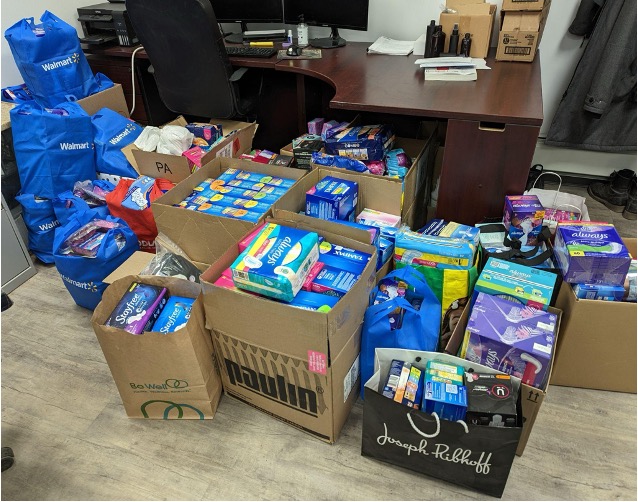
Many people who menstruate in Canada still do not have access to period products.
By Emma Bolzner
Living on the street as a teenager, Shawna Palm had the weight of the world on her shoulders.
Palm was in and out of the foster care system which resulted in her moving between the Sunshine Coast and Vancouver. Due to her situation, she was unable to access essential items, like menstrual products when she had her period.
“I would use old pieces of fabric,” Palm says.
More than one-third of women and girls in Canada were forced to make “budgetary sacrifices in order to afford menstrual products,” a 2019 research study by Plan International Canada Inc. found.
An additional 63 per cent had to miss out on work, school or other activities, due to not having access to period products. BIPOC, people with disabilities and trans and non-binary folks are also more vulnerable to experiencing period poverty.
“If you don’t have access to food, shelter or clothing, you are certainly not going to be spending any of your money on period products. That’s out of the question,” Palm says.
Palm’s shame and embarrassment because of this experience has made her one of the many people who support free menstrual products in Canada.
“Having access would have been an elevation in my dignity and a huge impact on my self-esteem,” Palm says.
In May 2022, B.C.’s provincial government announced they would be giving United Way B.C.’s Period Promise campaign $750,000 to continue to provide free menstrual products to shelters and people in need. The B.C. government has also been providing free menstrual products in public school washrooms since 2019.
Palm says that this is not enough.
“I think the issue for me was that I did not want people to know I was homeless or did not have a place to go. You just don’t reach out a lot of the time, especially when you are scared and ashamed,” she says.
“Especially when you are young, it is really hard to ask for anything.”.
Alexa Graf is the Capacity Building Specialist for United Way’s Period Promise Campaign, which donates free period products to community organizations across B.C.
Graf has noticed an increase in period product donations since the COVID-19 pandemic.
“We are seeing an increase in our donations, but also an increase in demand as more people hear about us. Whether it is an actual facility that you go to to get the products or have it sent to your home discreetly, I think the more access we have, the better for everyone,” Graf says.
BIPOC and people with disabilities are also more likely to experience period poverty every month, says Graf.
“In response to this, we are currently focusing on specific communities and seeing if reusable menstrual products can have a positive impact for those women,” Graf says.
Although initiatives like this can help, Palm believes period poverty still carries stigma because the products are kept concealed, as if they were something to be embarrassed about.
“The problem is they are on shelves hidden away shamefully. Nothing will change until we just have these products visible and out in the open,” Palm says.
Shayna Boucher, owner of the Ontario cosmetic store OC Beauty, hopes to eliminate the stigma around periods.
During the month of February, Boucher’s store was part of a period product donation drive and she asked her customers to donate menstrual products for the Women in Crisis centre in Sault Ste Marie.
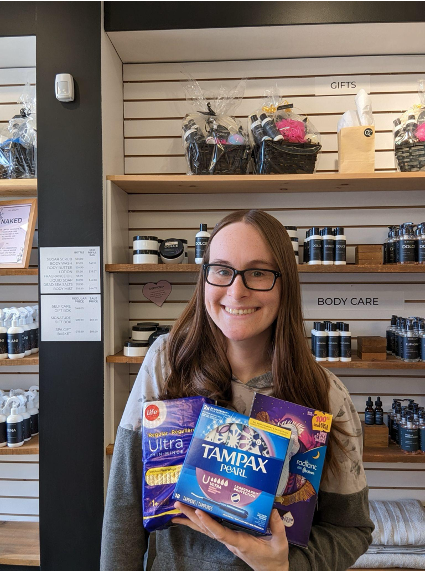
Boucher says when customers first heard about the donations they questioned why menstrual products were specifically being requested.
“Because nobody thinks to donate menstrual products,” says Boucher. “I knew I needed to do more for our community and period poverty is not talked about ever and nobody thinks about it. I constantly hear about food and hygiene product donations, but it is never specifically menstrual products.”
During college, Boucher says she witnessed a lot of her friends and classmates struggle with period poverty and it was one of the reasons she decided to take part in this initiative.
“I had a lot of friends that struggled financially and found themselves choosing between buying food and buying menstrual products. They were embarrassed because they were not homeless and they ended up missing school,” she says.
“Anytime I had extra money, I would go to the dollar store and buy some products to help them out. Nobody should feel embarrassed or be in that situation. It is unacceptable.”
Boucher was surprised by how many donations they received during the successful month-long drive.
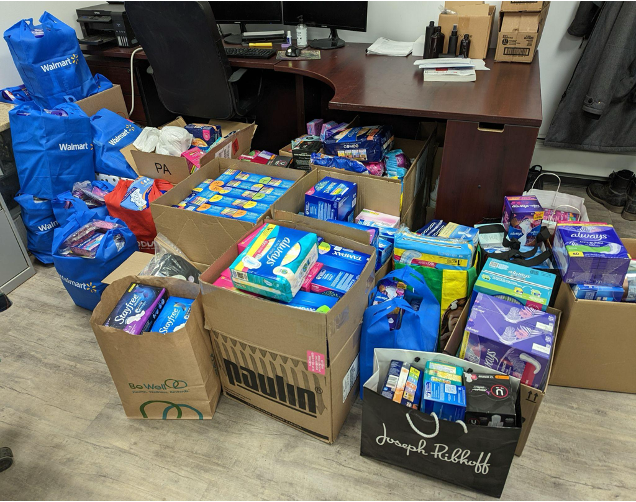
“The community came together and it was amazing. We collected 525 individual packages of pads, tampons and panty liners. I am still blown away,” she says. Due to this success, Boucher will be initiating more donations like this again in the future.
“We are going to talk with our pride community and collect products specifically for trans and non-binary youth. They are more at risk for asking for these products because they are outing themselves, especially if they are financially struggling or homeless,” she says.
Additionally, even those who have never experienced period poverty would like to have access to free period products in more public spaces.
“I 100-per-cent agree that free menstrual products should be more available because they are a necessity for women. Not a want, but a need,” says Veryna Schwuchow, a graphic design student at BCIT.
“I think they should be made available in public washrooms like in malls, movie theatres, restaurants and recreational facilities. I know a lot of restrooms have paid tampon dispensers, but I have tried to use them before and they did not work and who even carries change anymore?” she says
Katrina Fortushnick, a student at Sheridan College, has never experienced period poverty directly, but she also believes in free menstrual products being made more available.
“Everywhere should have free period products. It would make living a lot (less) stressful and would change the stigma around periods having this negative context,” Fortushnick says.
“It would make girls more comfortable with going out and living their life, without having to worry if they have a tampon or pad on them.”
Palm hopes to see more free period products in public spaces in B.C. even though she is not impacted by period poverty anymore.
“They should be handing them out like free candy. Having these products is non-negotiable,” she says.